Too many sales transformations I’ve witnessed don’t start with a plan.
They start with a bad quarter.
Throughout my career, I’ve seen catalog prices being divided by two, forced by new technologies that made our products obsolete.
I’ve seen services sold by our competition that turned our portfolio into a list of commodities.
And I’ve seen, within our key accounts, the signing power moving from our sole technical contact, then to the CTO and ultimately to the CFO.
All of this within less than three years.
And I am not the only one to have been in this situation.
All of this forces companies to rethink the way they do business.
That’s when they engage in sales transformation.
But not all companies approach transformation in the same way.
Some manage it as a continuous effort.
Others drive a ‘big bang’ when performance starts to decline and expect immediate results.
For those companies, transformation often starts too late following this loop:
- The numbers drop.
- The trend is not showing positive.
- The board asks questions.
- Leadership reacts.
- As a result, a transformation program is initiated.
How can you recognize that you are already in this situation?
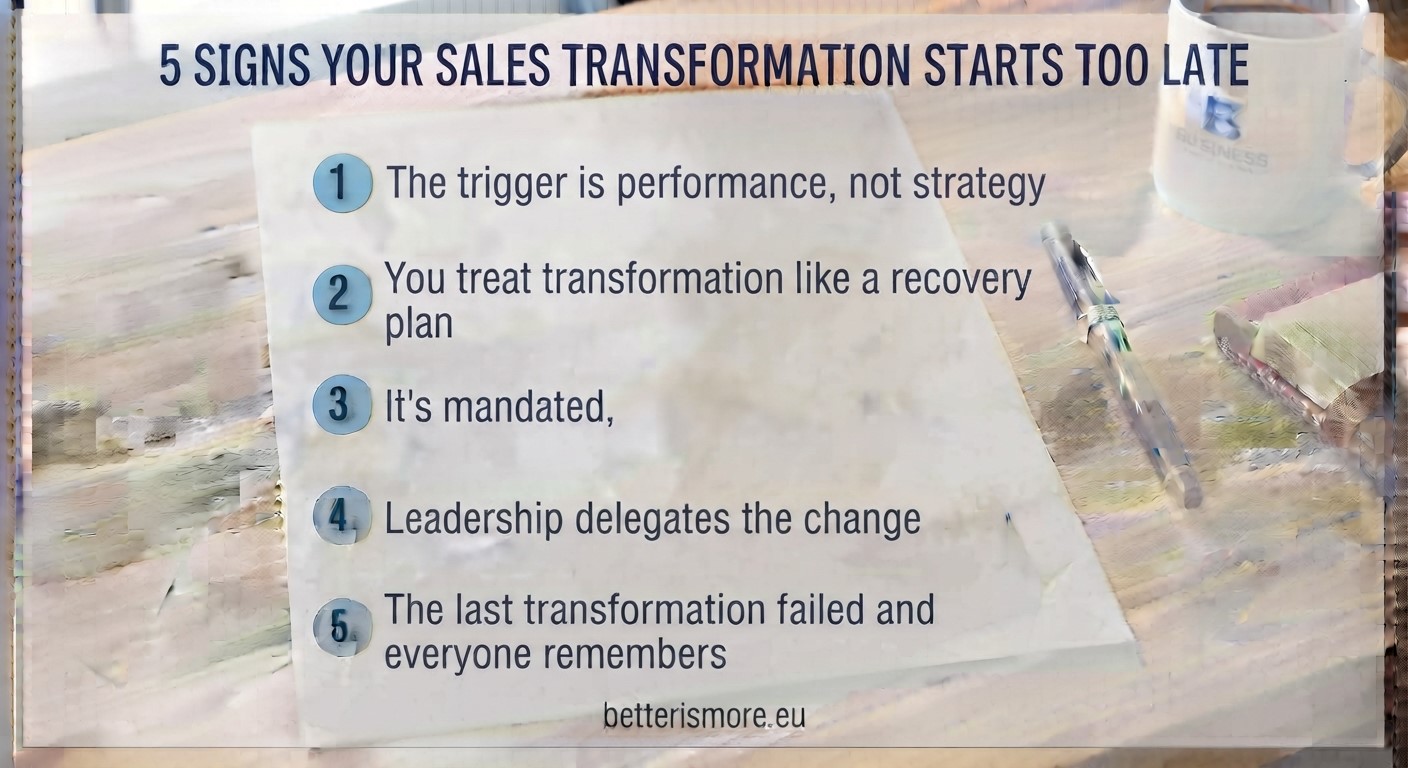
Here are five patterns I’ve seen repeatedly:
- The trigger is performance, not strategy
Numbers drop or targets are not reached year in year out and the trend is not showing positive signals.
Pressure builds and action gets taken. Fast.
Nobody stops to ask if the problem is structural or seasonal. Nobody puts any effort into diagnosing what’s actually broken.
The bad quarters become the trigger for a transformation that should probably have started much earlier.
- You treat transformation like a recovery plan
Emergency measures and short-term fixes, expected to deliver results fast.
Built to survive the quarter, not built to survive contact with year two.
The objective becomes getting the numbers back.
Not necessarily changing what created the problem in the first place. - It’s mandated, not owned
It comes down from the top. Too often poorly sold.
A company kick-off and a slide deck are only the beginning. They don’t drive adoption.
Sales executes because they have to, not because they are convinced.
This is compliance, not conviction.
And this becomes particularly visible when things get difficult. - Leadership delegates the change
The sign-off happens in the boardroom. Execution happens somewhere else.
The people who decided are not the people who carry it.
The whole company is watching: senior executives need to lead by example, not just check progress. - The last transformation failed and everyone remembers
New initiative. Same room. Same faces who lived through the last one that didn’t stick.
People have seen this before. They know how it usually ends.
So the result is often back to usual business, expecting this plan to be short-lived.
Same ingredients. Same outcome.
Big results don’t necessarily need big transformations.
A few targeted moves can sometimes have immediate ROI.
But the earlier you recognize that something fundamental is changing in your market, your customers or your sales model, the more options you have.
The question is not always: “Do we need a sales transformation?”
Sometimes the better question is: “Why are we waiting for the numbers to tell us?”
Let’s talk.